How to Credit People on a Song Cd Baby
Music Copyright 101: How to copyright your music and compositions as an artist, songwriter, or producer
As an independent musician, you ain your songs and recordings. Information technology'southward YOUR intellectual property.
That might seem obvious, only it'south worth repeating: You command the copyright to the songs you write and the recordings yous create. Buying of your music copyright gives you leverage, protection, and power when information technology comes to making money from your music catalog.
In this article we'll provide an overview of what music copyright is, how to copyright your music, and how you tin utilise your copyright as a songwriter or creative person to earn money.
What is music copyright?
Copyright signifies the ownership of intellectual property by a person or grouping.
Music copyright also grants certain exclusive rights to the possessor(south), one of the most important being the correct to earn coin from that intellectual property. This is chosen "exploiting" your copyright. We'll become into that more than afterwards.
Music copyright designates the ownership of a item song or recording
If you create a recording yourself, or if you pay for studio time and session fees, y'all own that sound recording. If you work with a label, at that place's a adept take chances the label controls the copyright to the recording — at least for some set up duration.
If you wrote a song by yourself, you alone ain that composition. If you wrote a song with one or more people, you each own a portion of that song. You and your collaborators would and so want to draft a document determining the splits (the percentage of the vocal each person owns), and register your copyright appropriately.
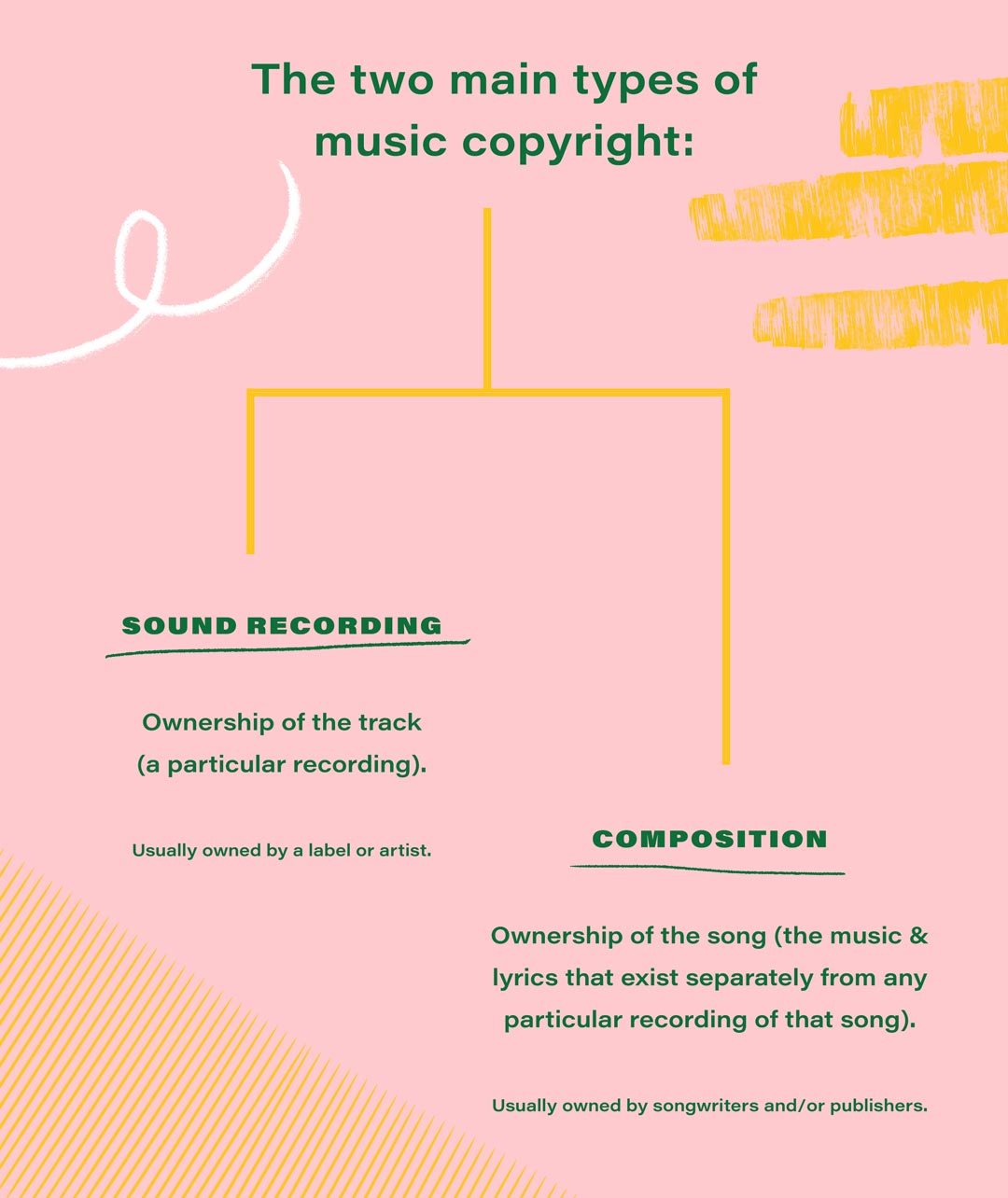
There are 2 types of music copyright
There are two types of music copyright:
- The composition — which is the music and lyrics
- The sound recording — which is a detail recorded version of that music and lyrics
Compositions are usually owned by songwriters and/or publishers. Sound recordings are normally owned by artists or labels.
When do you own your copyright?
In the strictest technical terms, you own your musical copyright the moment you capture the composition or recording in a fixed medium. This could be something equally simple as writing the melody or lyrics on a slice of paper or humming into a recorder.
Nonetheless, registering your copyrights with the U.S. Copyright Function entitles y'all to enhanced benefits. About important of all, in a groundbreaking ruling, the Supreme Courtroom has mandated that registration with the USCO is required before you can file a lawsuit and registering early on can earn y'all $150,000 plus attorney fees per deliberate infringement – simply simply if you register early on on.
Does the "poor man'south music copyright" actually count as proof?
The "poor human being's copyright" is a useless and ill-brash method for proving copyright. This is where a musician emails or sends a copy of the composition or recording to themselves via certified mail, leaving the bundle sealed with the date clearly marked on the outside.
The idea was that you would allow the authorities exercise the work of dating the creation of the piece of work with the federal postmark and that could provide you with enough leverage to file a lawsuit if your music was ever stolen or misused. However, this practice is now obsolete. In 2019, the Supreme Court ruled that you lot must register with the U.South. Copyright Function earlier you tin can file a lawsuit. The poor human's copyright does non grant you this right and and does not afford yous nearly the aforementioned protections as an official copyright registration.
Why would I want to register my copyright?
When your content is stolen or misused, your beginning thought may be to accept legal action. The get-go question y'all may be asked is, "Did you lot register with the Copyright Office?" That's because when you lot register, you take the ultimate leverage.
According to updated regulations, yous must register with the U.S. Copyright Function earlier you can file a lawsuit. Other types of registrations or mailing your music to yourself are non substitutes for USCO registration. Early registration tin can grant you a large payout – upwards to $150,000 per infringement PLUS your legal fees, simply only if you register earlier your music is stolen or misused.
| Registering Now | Registering After Your Music Is Stolen/Misused | |
| Y'all can file lawsuits immediately in federal courtroom or small claims court (no chaser required). Receive upwardly to $150,000 PLUS attorney fees per willful infringement. | Can't file a lawsuit until yous accept received your official registration from the USCO. (commonly 3-9 months) Receive up to $200-$xxx,000 per piece of work (barely plenty to encompass legal fees). |
Registering with the U.Southward. Copyright Office is one of the most important actions you can take and it's something that you should want to practise presently after or earlier your music is released.
A registered work is your only ticket into court and it volition carry a lot more weight than a sealed package, a Soundcloud link, or beer-soaked napkin.
In the USA, you'd want to annals your copyright with the US Copyright Office , part of the Library of Congress.
How to register a copyright for your songs
If yous desire to legally annals a copyright for your music in the USA, you lot'll demand to do that directly with the Copyright Role , or you can employ Cosynd, a service that handles all the heavy lifting for you.
The reward of using Cosynd is information technology's much more user-friendly than the numerous steps involved when you lot register direct with the Copyright Part. CD Baby partnered with Cosynd over other companies who offering like services because their interface is piece of cake to navigate, their procedure is quick, and they're efficient and professional every step of the fashion.
Compared to other services, Cosynd lets you register multiple songs on one awarding – some services merely let you annals 1 at a time. Most important of all, Cosynd is fourscore% less expensive compared to like services.
Here are the things y'all'll need to annals your copyright using Cosynd:
- The full legal names and country of citizenship/domicile of your co-authors
- The total legal name and addresses of the owners of your copyright
- The twelvemonth of completion, date of of release (if released), and the nation of in which your copyrights were released.
- Sound files if yous are registering your audio recordings. Audio files or lyric/chord sheets if yous are registering just your compositions.
Cosynd asks you lot a series of questions to determine the best fashion for them to file your registrations on your behalf. You won't need to larn about the various application types alee of time.
For more on how to register your copyright, caput here .
If you're registering your music copyright directly with the U.S. Copyright Office past yourself, you'll want to file:
- Form PA for a limerick
- Course SR for a audio recording
Be sure to read all of the Copyright Office's circulars on the applications types first – if your music is released, unreleased, or varied in authors there are dissimilar applications types that should be used (over again, when you utilize Cosynd, they automatically make up one's mind the right blazon of application to use when filing your registration, and then you lot don't accept to think about this).
What about if yous desire to register both the sound recording and the limerick? Run into below.
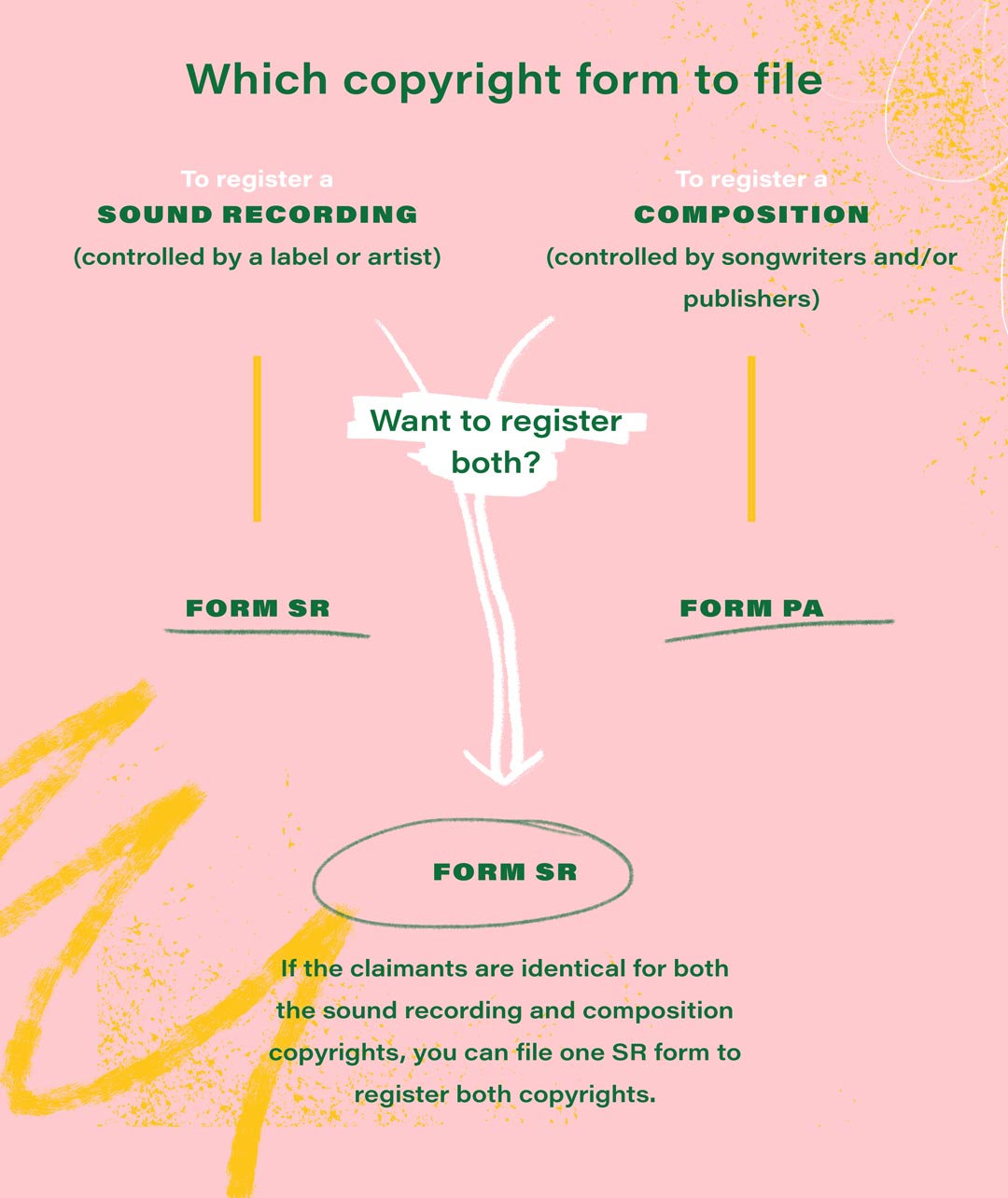
Co-ordinate to copyright.gov, you can use 1 form (SR) to annals both the sound recording AND limerick, every bit long every bit the author and owner are exactly the same for all songs listed on the awarding and the release information is the same.
Course SR must also be used if you lot wish to brand ane registration for both the sound recording and the underlying work (the musical composition, dramatic, or literary work). Y'all may make a single registration merely if the copyright author and claimant is the aforementioned for both the sound recording and the underlying piece of work.
How onetime practise I accept to be to copyright my music?
There is no age requirement to copyright your music.Nonetheless, while copyrights are governed by federal law, nigh copyright transactions are governed past state police force. State music copyright law can differ from federal law in what minors tin can and cannot do with their copyright. This includes certain changes that can occur in some states when the private who owns the copyright turns eighteen. CD Infant'south Joel Andrew explains these rules in his copyright article.
What options do I have if I desire to file a lawsuit?
In that location are two places where you can file a lawsuit for infringement – in federal court and soon, in small claims court. To take advantage of either pick, you must register with the Copyright Office offset, mostly earlier the infringement happens if you want to get the highest possible reward.
- Federal Courtroom – You tin file your lawsuit in federal court. If you exercise and so, participation is mandatory for you lot and your infringer. Creators that can win their case in federal court could earn $750-$150,000 per infringement. Litigating a case in federal court from start to finish requires an attorney costs an average of half dozen figures. A more affordable option via pocket-size claims court exists (encounter below).
- Small Claims Court – The Copyright Culling in Small–Claims Enforcement Act of 2019 (the CASE Human action) established a voluntary small claims court within the U.Due south. Copyright Office. It will be accessible to creators at the end of 2021. Small claims courtroom is an easy, accessible, and affordable option for all copyright owners to file claims of infringement and other grievances and reduce legal expenses. A Copyright Claims Board (CCB) comprised of three judges will try cases virtually (copyright owners volition not have to appear physically in person in a federal court). Creators can represent themselves and practice non need to hire an chaser. Copyright owners could recover upwardly to $thirty,000 per example, with a cap of $xv,000 in statutory damages per work infringed. Guest blogger Jessica Sobhraj wrote this informative commodity about the implications of the Case Human activity.
How practice I make money from a sound recording?
When you lot own the rights to a sound recording, y'all control the "principal rights" and can grant a main license. Royalties that flow from the granting of a master license include streaming and download revenues associated with the recording, from platforms like Spotify, Amazon, Apple Music, Deezer, etc.
You besides can grant permissions for sync licensing and sampling of your recording. (More on those topics below).
Exterior of the United States, you're owed royalties when your rail is played on the radio; inside the Us you're owed royalties when your rail is played on digital or satellite radio. (More than on that beneath too).
Lastly, as the possessor of a recording you can printing and sell physical formats such as vinyl and CDs.
How do I make coin from my composition copyright?
Once you've registered your music copyright, information technology'south time to exploit that copyright. Exploitation may have negative connotations in other parts of society, just in the music business organisation it's how you earn money from the hard piece of work yous put in to writing your song.
Operation Royalties
Equally a songwriter, y'all have the right to collect publishing royalties for the usage of your song. 1 such revenue stream is performance royalties, owed to the songwriter and publisher whenever a song is:
- spun on the radio
- performed in public
- played in a eating house, bar, etc.
Equally a songwriter, yous'll want to register with an agency that collects operation royalties. These agencies are called performing rights organizations (PROs).
We accept 3 major PROs (and a few smaller ones) in the U.S.:
- BMI
- ASCAP
- SESAC
You tin can chapter yourself as a songwriter with the outset two straight, or by using our publishing assistants service CD Babe Pro Publishing. With CD Baby Pro Publishing, we'll affiliate you with BMI or ASCAP (your choice), and annals your songs with them. SESAC is invite only and represents far fewer songwriters. If you lot're outside the Us, run across this list of international PROs and collection societies.
The job of these PROs is to monitor radio stations and venues for public use of your song. Whatsoever time your vocal is played in public it generates a performance royalty for the underlying composition, and as the songwriter for that composition, you lot're entitled to the operation royalty.
You tin can also earn performance royalties by playing your songs live. The venues should be paying fees to the PROs to encompass these royalties, and each PRO gives you a manner to register your alive sets. When you're on tour make certain to log all of the venues you played and go on runway of your fix-lists so you can register those shows when you're dwelling! A curious quirk virtually functioning royalties is that they're but generated for songwriters and their publishers; the PROs practice not pay any revenue to recording artists.
Mechanical Royalties
When your composition is reproduced in any medium you are owed a separate type of royalty called a mechanical royalty.
These are royalties that PROs like ASCAP and BMI do NOT collect.
You might have heard of mechanical royalties every bit they relate to the manufacturing of physical formats such equally CD, vinyl, and cassettes. Only digital formats also generate mechanicals. When someone streams your music on a service like Spotify or Apple Music, or when they purchase a download from a store like iTunes, your composition is technically existence recreated. Yes, even though — in the example of streaming — it's a temporary reproduction.
These mechanical royalties are reported by the streaming and download platforms to the royalty collection club in the country or territory where the stream or download happened.
In the U.S. we have the Harry Play tricks Agency; but almost every country has a like agency to collect mechanical royalties. The U.South. is unique in that mechanicals from downloads are bundled in with the revenue from the sound recording. So those will be paid to you through your music distributor. This does not utilise to interactive streams though; in every land, mechanical royalties generated by interactive streaming are paid to collection societies.
Why can't you collect mechanical royalties on your own?
Technically you could, but it'southward very hard and time-consuming.
Mechanical royalties are only payable to publishers, then you're not able to collect them as a songwriter. To make things more complicated, it's very difficult for virtually independent songwriters to register with Harry Fox equally a publisher because you'd need to have a sizable catalog of songs. Luckily, CD Baby is here to act equally your publishing ambassador and make all this super simple. If you sign up for Pro Publishing we'll register your songs with collection societies worldwide and help you collect ALL your publishing royalties.
Streaming generates meaning mechanical royalties, and you're most to earn even more than.
CD Infant played a office in recent successful efforts to increase the mechanical royalty rate owed for interactive streaming. Streaming services are now required to increase their payouts to songwriters and publishers each twelvemonth through 2022, when the rate will reach 15.1% of total revenue earned.
That's a 44% hike in the royalty rate.
This is a big win for songwriters, so information technology's more important than ever to professionalize your rights every bit a composer or lyricist.
What royalties am I owed as an artist?
If you're the recording creative person on a song, there ARE royalties you can earn, but they're nerveless and paid differently from publishing royalties. Like we covered to a higher place, artists in the USA are not entitled to royalties from terrestrial radio airplay, but satellite radio and Internet radio is entirely different.
If your song is played on Pandora or on a satellite radio station, this generates a different type of royalty for the usage and creation of the sound recording — think of information technology as a digital performance royalty. This blazon of royalty is but owed to recording artists and audio-recording rights holders (ie. the record label). And dissimilar the multitude of PROs in the U.S., there's only ane game in town for artists to register and collect those royalties: Soundexchange .
Register your songs with them and let the Pandora cash starting time to menstruum !
What if someone wants to record my song?
Thus far nosotros've covered the utilise of your song in traditional, satellite and Net radio airplay, but there's notwithstanding another way to exploit your copyright. Let's say your composition and audio recording is registered and your song is out in that location in the earth, and someone hears it and falls in love. They happen to exist a musician themselves and they desire to record their own version of your song. Great! And they want to release a cover of your song legally. Even meliorate!
The good news is this person has an easy avenue through which to obtain the rights to record their estimation of your composition. Whatsoever original vocal that is commercially released is eligible to be licensed for the charge per unit of 9.1 cents per copy. This is called a compulsory license, meaning that as long as this mystery person pays you lot that mechanical licensing fee (normally through the Harry Play tricks Bureau), they have the legal correct to record their interpretation, which is chosen a "cover song" in the business concern.
That may or may not exist more than good news, but whether you lot approve or disapprove of a death metallic embrace of your audio-visual love ballad, as long as they pay the compulsory fee the artist is protected. The same laws that protect you from copyright infringement too protect artists' creative vision, no matter how amazing or absurd. It's the circle of life via capitalism.
What if someone wants to use my actual recording?
At present, at that place are two more types of exploitation we oasis't talked about, and they both relate to someone who wants to use your music in their own song. If someone wants to employ your sound recording in their ain rail, that's called a sample. Unlike licensing for a cover song, this is something you have control over as the recording creative person, songwriter, or label — because ALL samples, no matter how brusk or long, must be legally licensed .
The person seeking to use some portion of your recording in their own recording must contact you (or the rights holder to your audio if you signed an agreement with a label) to enquire permission. The rights holder (You) tin can either corroborate or deny the use of your music in a sample. If you're an independent artist you'll have control over your sound recording copyright, and if you corroborate of this use you can negotiate the fee the other political party would need to pay to secure the right to employ your recording. If yous concur the rights to both the composition and the sound recording yous can grant permission for the apply of both.
Sync licensing
The second type of exploitation of your recording or composition happens when someone uses information technology in other media such equally a moving-picture show or TV show. This is called sync licensing, since your music is synchronized with the visual medium.
Much like the instance with sampling, the music supervisor with the product company who is seeking to use your song must contact the rights holder or license the vocal from a music library if yous chose to add your song to i. If they contact you for this you can negotiate a fee with them. Equally in the instance with clearing a sample, if yous hold the rights to both the composition and the recording you can grant permission for both in one understanding, which is appealing to music supervisors who need to motility fast to secure songs on a tight production schedule. If your music is included in a music library, that agency can negotiate the terms of the license on your behalf.
The upfront placement fee is one blazon of revenue generated from a sync deal. Later on that placement is secured and the bear witness or motion picture is aired, yous are owed performance royalties each fourth dimension your vocal is played in that medium, provided the music supervisor files the cue sheets.
Sync rights kinda sorta utilize to YouTube too!
Sync licensing also applies to YouTube videos of cover songs . So if a YouTuber records a embrace of your song and wants to mail the video, the mechanical license they acquired to distribute a recording of that vocal does non cover them for the video. They'll need to secure a sync license from you.
Merely allow'southward be clear: MOST people on YouTube are not getting sync licenses for the music they use. That'south why YouTube developed Content ID. When some YouTube awareness doesn't desire to clear the sync rights with y'all direct, they can upload their video and allow YouTube to place a claim on their video via Content ID.
And this doesn't just piece of work for cover songs, simply your recordings too. If someone put your rail behind their wedding highlights video, you'll earn ad acquirement.
If you opted in for Social Video Monetization with CD Infant we'll transport your vocal to YouTube and add it into their Content ID database. That will automatically catch any use of your vocal in a video and monetize it accordingly. YouTube ads can add up to real acquirement, so even if this person does non clear the sync license, y'all'll be earning coin from their video.
Closing thoughts
Now that you know the WHAT, HOW, and WHY of music copyright, it's time to make some money from your hard work! Luckily, CD Baby has a number of services that can help yous navigate the wide globe of copyright we've discussed in a higher place:
- Cosynd — The easiest fashion to register your copyright.
- CD Babe Pro — Worldwide publishing assistants and royalty collection.
- Sync licensing — We'll add together your songs to our music library for possible placement on networks like HBO, FX, NBC, Offset, and many more.
RELEASE MUSIC WORLDWIDE
carpenterthavispeas.blogspot.com
Source: https://diymusician.cdbaby.com/music-rights/copyright-for-musicians/
0 Response to "How to Credit People on a Song Cd Baby"
Post a Comment